

What Do Vets Ask AI During Clinical Practice? Choonok Company Releases Preprint on AI Query Patterns Across Clinical Stages
Choonok Company Maps Veterinary AI Use Into 3 Categories and 21 Query Types
Choonok Company has released a preprint examining how veterinary professionals use AI across different stages of clinical practice.
The study, titled “Development of an Exploratory Taxonomy for Veterinary Professionals’ AI Query Patterns Across Clinical Stages: An Expert Panel Study,” aimed to systematically classify AI queries in veterinary practice according to clinical stage and purpose. The paper was posted on bioRxiv on June 9, 2026.
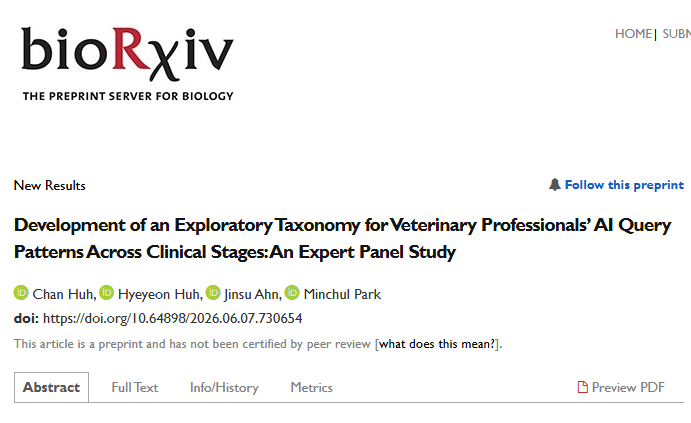
Read the Preprint: An Analysis of Veterinary Professionals’ AI Use Across Clinical Stages
Choonok Company’s research and development team first analyzed 5,372 real-world queries collected over eight months from a veterinary clinical AI chatbot to develop an initial taxonomy.
The framework was then refined through a review of relevant literature and a structured survey involving 38 veterinary professionals currently working in clinical practice.
The resulting taxonomy classified AI queries into three major categories and 21 subtypes:
Clinical Support · Evidence-Based Research · Terminology & Drug Information
When experts were asked to select their top query type at each clinical stage, differential diagnosis reasoning was the most frequently selected overall. It was particularly preferred before consultations, after diagnostic results became available, and during non-clinical hours.
By contrast, in the post-consultation stage, clinical decision support—including decisions related to hospitalization, follow-up, and treatment planning—was the most frequently selected type, accounting for 55.3% of responses.
Differences were also observed according to clinical experience and workplace setting. Veterinary professionals with 10 or more years of clinical experience selected evidence retrieval more frequently than those with less than 10 years of experience. Among experts working at universities and teaching hospitals, evidence retrieval emerged as the most prominent query type.
AI Should Adapt to Where Vets Are in the Clinical Workflow
The study suggests that veterinary AI should not deliver the same type of response to every user.
Instead, the structure, depth, and type of information provided may need to vary depending on the stage of care, clinical experience, practice environment, and purpose of the question.
The findings also highlight the need to evaluate veterinary clinical AI beyond simple answer accuracy. Evaluation frameworks may need to reflect the types of questions veterinarians actually ask in practice, including differential diagnosis, treatment protocols, clinical decision support, and evidence retrieval.
Building on the taxonomy developed through this study, Choonok Company plans to continue developing clinical AI systems and evaluation frameworks that better reflect real-world veterinary workflows and information needs.
© CHOONOK Company. All rights reserved. Unauthorized reproduction or redistribution of this content is prohibited.

![[NEWS] CHOONOK Company Unveils Veterinary-Specific LLM, “VetJarvis-4B-Instruct”](https://static.wixstatic.com/media/a738d3_8a99978d2d0840f3b0cfa640094ee083~mv2.jpg/v1/fill/w_980,h_511,al_c,q_85,usm_0.66_1.00_0.01,enc_avif,quality_auto/a738d3_8a99978d2d0840f3b0cfa640094ee083~mv2.jpg)
Comments